Looking Up
Within, without — the search for meaning doesn’t move outward, it folds back in.
We spend three-quarters of our lives looking down. Our eyes cast toward the ground, we follow the paths laid out before us, sonder simmering quietly on the outskirts of others’ lives. We walk by, unnoticed extras in the films of those around us. We talk, we laugh, we cry—pouring ourselves into emptiness, into spaces we think no one sees. Spaces where we hide.
But what would happen if we looked up more? If we wondered?

For me, looking up is a ritual. Each night after work, I step out of my car and pause in the driveway. Gravel crunches underfoot, grounding me for the moment before my eyes instinctively find the brightest star. The sky above feels as infinite as it did when I was a kid, lying on the lawn with my arms crossed behind my head, staring upward at the secrets too vast and distant to give themselves away easily.
When I was little, I wanted to know everything. Why was the ground so hot on summer days? Why didn’t the stars warm us like the sun? Why did the moon follow us home? Patient and kind, she indulged my endless questions with answers that hovered somewhere between fact and magic.
“The stars don’t burn us because they’re too far away,” she said once, her face soft under the cabin’s porch light. “Their fire fades before it can touch us. If they were closer, they’d burn us just like the sun. But they keep their distance so we can look at them without fear.”
Her answers always felt like enough—until they didn’t.
It was around the time she got sick that my questions changed. Will she get better? How long do we have? What happens when she’s gone? Questions no one could answer, not even her.
And then, one night, months after she was gone, I stood in the driveway, staring at the stars, and realized I hadn’t looked up in all that time. It felt foreign, almost wrong, as if the universe had shifted while I was busy looking away with my head down to the grind.
The brightest star in the sky caught my attention, just over the neighbor’s house. It pulsed gently, like a heartbeat. I wondered, as I often did as a kid, how long its light had traveled to reach me. The speed of light is finite—187,000 miles per second—or so they say. Yet the light entering my eyes that night might have left its star centuries ago. Millennia, even.
I thought of her then. Of how far away she felt, and yet how much of her love still reached me, even now.
She used to say, “Things closer to us sting more.”
Her words stayed with me, lodged in the crevices of my mind like seeds, waiting for the right moment to grow. Those words led me to vast books and documentaries on everything from the vastness of space, to our deep inner psyche that makes us think, walk and talk, to questions too big to answer and answers too small to satisfy.
Now, standing under that same sky, I asked myself: What would she want me to do with this life? Would she want me to spend it looking down, trapped in the grind of the everyday, as we all so often do? Or would she want me to look up more, to question, to wonder, to think bigger?
The thought sparked something in me—a restless curiosity, a desire to create, to chase wonder for its own sake, to snap a towel at its ass and laugh as it turned to face me.
I stepped back from my car, letting the chill of the night seep into me, my breath crystallizing in the air. The stars were clearer tonight than they’d been in months. Extremely cold nights can do that. I stayed there for what felt like an eternity, asking questions I didn’t need answers to because I already knew them.
And in that moment, I decided that looking up wasn’t just a ritual. It was a pact.
A pact to her. A pact to him, to them. A pact to myself. A pact to the questions that make us human.
I threw my work bag over my shoulder, walked up the pathway to the front door, and pushed it open. The warmth of a love-filled home kissed my face, the arms of my wife around my neck, and soon, the delighted squeals of my children pulled me into a wrestling match I could never lose.
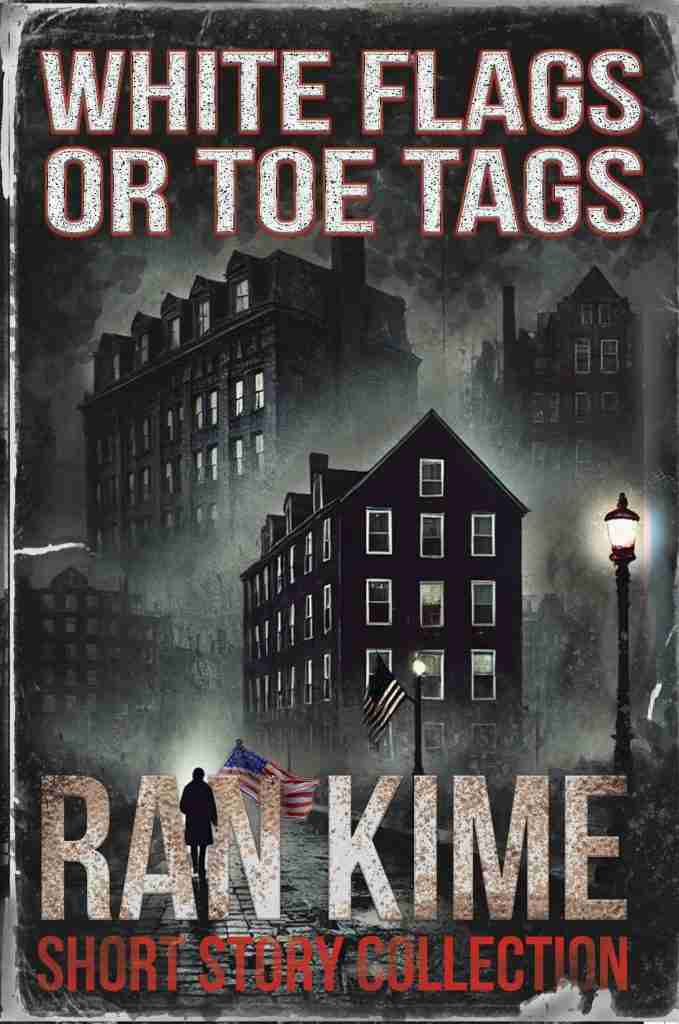
Dark psychological short story collection
- Psychological noir short stories rooted in survival and moral ambiguity
- Characters pushed to the edge of loyalty, violence, and self-destruction
- For readers who crave unflinching literary fiction without clean endings
A collection of dark psychological short fiction focused on endurance, moral fatigue, and the damage that accumulates when survival replaces hope. These stories follow characters navigating addiction, grief, inherited silence, and the quiet consequences of past decisions.
The pieces move nonlinearly, allowing memory and perception to distort reality. This is fiction about negotiating damage rather than escaping it — and living with what remains.
Paperback · 6×9 · 104 pages · ISBN: 979-8348118822
Prefer digital? Buy eBook
“I tried to remember why I’d come. What did I need? My hands fumbled through my pockets, searching for a breadcrumb of purpose. Empty. The middle console offered nothing but old receipts and baby cake napkins until my fingers landed on a for- gotten lottery ticket—a crumpled promise of nothing.”
Books by Ran Kime